Core Curriculum 2026

The Fundamental Mechanics of Asset Ownership

A high-level educational series designed to introduce entry-level participants to the professional principles of capital stewardship and strategic growth.

01

Principles of Capital Stewardship

Capital Stewardship

From Saving to Strategic Ownership

At the highest level of financial literacy, we transition from the concept of "saving" to the discipline of "stewardship." Stewardship is the responsible management of resources to ensure long-term viability. For a new market participant, this means viewing every unit of capital as a tool for potential economic participation rather than a static reserve. This cognitive shift is the foundation of all professional wealth management.

Effective stewardship requires a rigorous understanding of Time Horizon. In 2026, the global economy rewards those who can look beyond the quarterly news cycles. By establishing a 10-to-20-year vision, you effectively neutralize the noise of daily market fluctuations, allowing your strategic decisions to be driven by data and historical trends rather than emotional reactions.

02

Systemic Risk Assessment

Risk Assessment

Identifying and Mitigating Exposure

Risk is an inherent characteristic of any economic system. However, professional participants distinguish between "uncompensated risk" and "compensated risk." Uncompensated risk—such as placing all capital into a single, unvetted instrument—provides no strategic benefit. Compensated risk, conversely, is the calculated exposure to market growth in exchange for long-term returns.

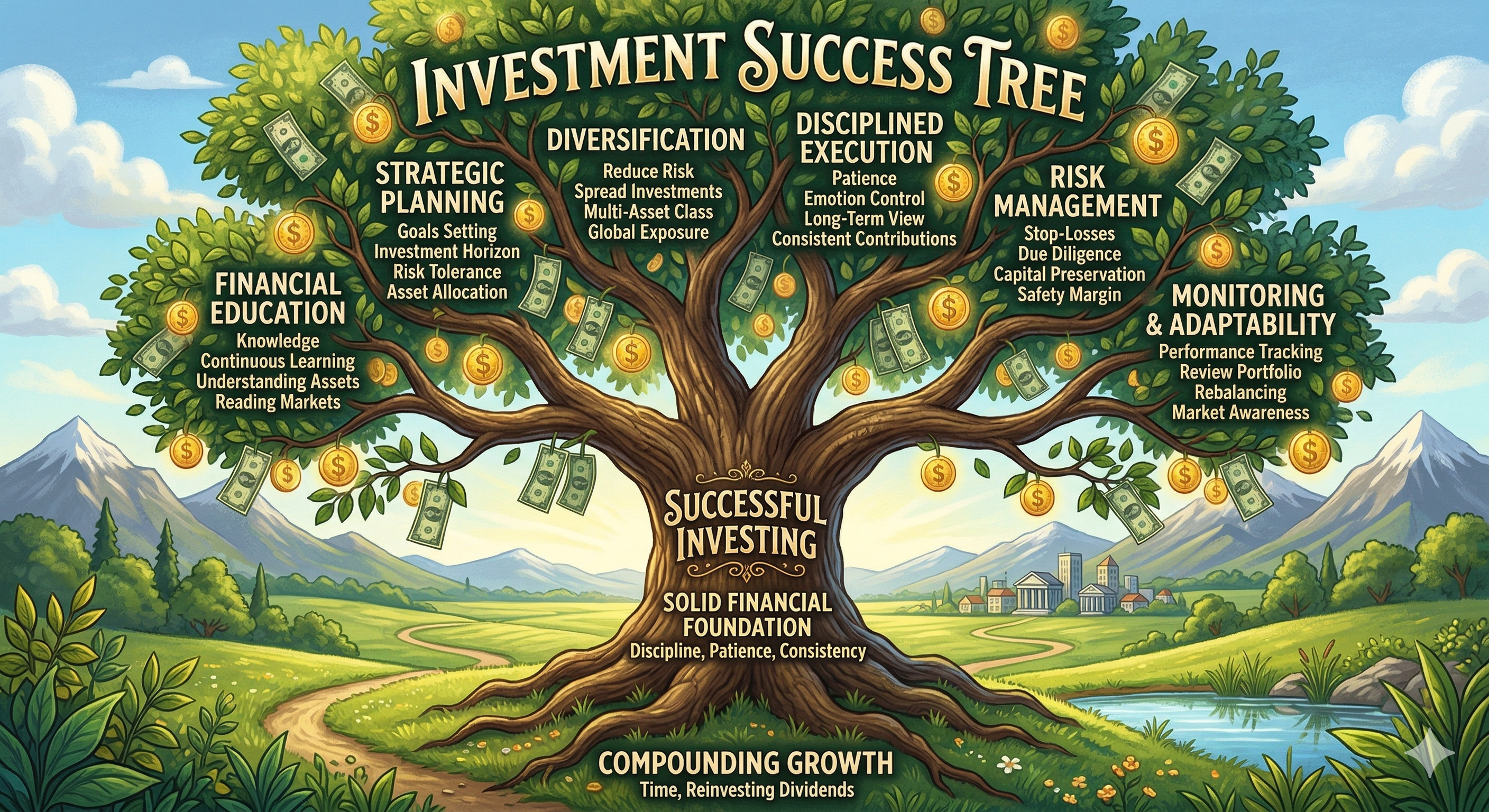
The Resilience Principle: A truly resilient portfolio is built to function under stress. By diversifying across different asset classes, currencies, and geographical regions, you ensure that no single systemic failure can compromise your entire financial framework.

Modern risk assessment in 2026 also involves a deep dive into liquidity. Ensuring that you have immediate access to a portion of your resources protects you from being forced to liquidate long-term positions during a market correction. This "liquidity buffer" is the primary defense mechanism of the successful individual.

03

Architecture of Diversification

Diversification Architecture

Building the Multi-Sector Shield

Diversification is often misunderstood as simply "owning many things." In professional financial architecture, diversification is the selection of assets with negative correlation. This means when one sector faces headwinds, another sector within the portfolio is structurally positioned to provide stability or growth. This balancing act is what allows for a smooth trajectory in an unpredictable global economy.

As we navigate the technological and industrial shifts of the mid-2020s, diversification must also include exposure to emerging infrastructures. By balancing traditional stability with forward-looking sectors, a participant creates a portfolio that is both protected from the past and prepared for the future. This architectural approach is the hallmark of sophisticated capital management.

Begin Your Professional Education

Subscribe to the "Asset Academy" Weekly Briefing. Get high-level analysis on capital stewardship and market mechanics delivered to your professional inbox.